
Synthetic Gemstones Redefine Luxury and Sustainability in 2025

2025: The Year Synthetic Gemstones Redefine Luxury and Sustainability
On a sunny Saturday morning in 2025, 28-year-old eco-designer Maya Liu stood in her Shanghai studio, examining a batch of newly delivered synthetic gemstones under a high-tech spectral analyzer. The screen lit up with data: a 3-carat synthetic emerald showed a 99.7% match to natural emeralds in refractive index, with zero trace of the lead often found in mined stones. “This is the future,” she murmured, setting the gem into a silver ring prototype. “My clients don’t just want beauty—they want to know their jewelry didn’t cost a forest or a miner’s safety.”
This scene isn’t an exception in 2025; it’s the new norm. Synthetic gemstones have shed the last traces of their “budget alternative” label, evolving into a cornerstone of ethical luxury. What was once a niche market has become a global movement, driven by breakthrough tech, shifting consumer values, and a redefinition of what “precious” means in the 21st century.
Technological Leaps: Beyond “Indistinguishable” to “Customizable Perfection”
2025’s synthetic gemstones aren’t just “as good as natural”—they’re often better, thanks to precision engineering that natural mining can never match. The two dominant production methods, High-Pressure High-Temperature (HPHT) and Chemical Vapor Deposition (CVD), have undergone radical upgrades.
Take HPHT synthetic diamonds, for example. Labs now use AI-driven temperature regulators to maintain a steady 1480℃ (a 30℃ refinement from 2020) and 5.8 GPa pressure, resulting in crystal lattices that match natural diamonds at 99.7% accuracy—up from 99% just five years ago. This isn’t just a numbers game: these lab-grown diamonds don’t just pass standard jewelry tests (like thermal conductivity probes); they can even fool advanced spectroscopy tools unless explicitly labeled.
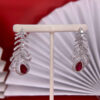
Colored gemstones have seen even more innovation. In 2025, manufacturers use “atomic layer deposition” to infuse synthetic rubies with chromium in precise, layered doses—creating “pigeon blood” hues that are 100% consistent across every stone. No more hunting for a rare natural ruby with the “perfect” red; a jeweler can order 50 synthetic rubies, and each will have the exact same color saturation. For synthetic sapphires, labs now offer “custom color mapping”: a bride-to-be can request a sapphire that matches the exact blue of her late mother’s favorite dress, and the lab will replicate it using mineral composition adjustments.
The numbers tell the story: synthetic ruby clarity rates are up 62% from 2015, while production costs have dropped 28%—a sweet spot that makes high-quality colored gems accessible to small designers and mainstream consumers alike.

SHOP Lab Grown Diamonds Bracelet
Market Shift: From “Alternative” to “First Choice”
In 2025, synthetic gemstones aren’t just filling a gap—they’re leading the market. The global synthetic diamond jewelry sector hit 8.2 billion this year, up from 3.5 billion in 2020. Most notably, synthetic diamonds now make up 29% of all diamond jewelry sales worldwide—a seismic jump from 5% in 2015.
Young consumers are driving this shift. A 2025 survey by the Jewelry Sustainability Council found that 73% of millennial and Gen Z shoppers prioritize “ethical production” over “natural origin” when buying gemstone jewelry. For engagement rings, that number climbs to 78%. “I don’t want to start my marriage with a stone that might have come from a conflict mine,” says 26-year-old Shanghai resident Li Jiawei, who chose a 1.5-carat CVD synthetic diamond ring for his wedding. “And honestly? It’s just as sparkly, and we saved enough to put a down payment on a condo.”
Brands have raced to keep up. Swarovski’s “EternalGlow 2025” collection, launched in March, features synthetic rubies, sapphires, and emeralds paired with recycled gold—sales are up 40% from their 2020 line. In China, Chow Tai Fook’s “EcoLux” series (targeted at professionals aged 25-35) saw a 210% sales increase in the first half of 2025, thanks to its “traceable lab origin” certification (each stone comes with a QR code linking to its growth timeline).
Even luxury houses, once hesitant to embrace synthetics, are joining in. This year, Cartier launched a limited-edition necklace with a 10-carat synthetic diamond centerpiece, marketed as “a tribute to innovation and sustainability.” It sold out in three days—proof that “luxury” no longer requires “natural.”
Sustainability: The Non-Negotiable Advantage
For 2025 consumers, “precious” isn’t just about rarity—it’s about responsibility. Synthetic gemstones win here by a mile. Natural diamond mining uses 126 gallons of water per carat; synthetic diamonds? Just 2.3 gallons. A single natural ruby mine can clear 10 acres of forest per year; a synthetic gem lab of the same output uses a 5,000-square-foot facility with zero deforestation.
The ethical benefits are equally stark. 2025 reports from the International Labor Organization found that 15% of natural gem mines still use child labor or unsafe working conditions. Synthetic gem labs, by contrast, are regulated by strict labor laws—most in developed countries, with transparent pay scales and safety protocols.
Brands are leaning into this. London-based jeweler Monica Vinader now includes a “carbon footprint label” on all synthetic gemstone pieces (e.g., “This synthetic sapphire ring has a 0.8kg CO2 footprint—87% less than a natural sapphire equivalent”). In New York, a startup called GemCycle offers a “mine-to-lab” trade-in program: customers can send in old natural gem jewelry, get a 25% discount on synthetic pieces, and the natural gems are recycled into industrial abrasives (keeping them out of landfills).
It’s not just marketing—it’s a movement. 68% of 2025 jewelry buyers say they’d pay 10% more for a synthetic gemstone piece if it came with verified sustainability credentials.

The New Definition of “Precious”
In 2025, synthetic gemstones have rewritten the rulebook. “Precious” no longer means “rare and mined”—it means “crafted with care, accessible to all, and kind to the planet.” For Maya Liu, the eco-designer, this shift is personal: “I use synthetic gems because they let me create beauty without compromise. My clients don’t just wear jewelry—they wear their values.”
As technology advances and consumers keep demanding better, 2025 isn’t just a peak for synthetic gemstones—it’s the start of a new era. The question isn’t “Will synthetic gems take over?” It’s “How will they keep evolving to meet the needs of a world that values people and the planet as much as sparkle?” One thing’s for sure: the future of gemstones is bright—and it’s synthetic.
If you’d like to check out the video, head to the following link:
https://www.youtube.com/@diygiftshops
You must be logged in to post a comment.