
2025 U.S. Lab-Grown Diamond Market

By 2025, the U.S. lab-grown diamond (LGD) market has moved beyond the early “niche curiosity” phase and firmly established itself as a core segment of the broader diamond industry. This transition is marked by scaled production, diversified consumer demand, and a reshaped competitive landscape—all while navigating tensions between technological innovation and market equilibrium. Below is a detailed breakdown of its key features:
I. lab-grown diamond Market Scale: Penetration Hits a Tipping Point, Segments Diversify Dynamically
- Overall Growth: From Niche to Mainstream
In 2025, the U.S. LGD market is projected to reach USD 12–13 billion, a more than 10-fold surge from 2020’s USD 1.1 billion. This growth is driven primarily by the jewelry sector, which accounts for 85% of the market (USD 10.2–11 billion), while industrial applications make up the remaining 15% (USD 1.8–2 billion). A defining milestone is lab-grown diamond penetration in core jewelry categories: it now represents 47.7% of all engagement rings sold and 42.1% of total diamond jewelry sales—a stark contrast to 2019, when its share in both segments was below 5%.
- Segmented Dynamics: Contrasts Between Wedding and Everyday Markets
- Wedding Market: A Tale of Two Tiers
While lab-grown diamond dominate mid-range engagement rings (USD 1,500–5,000), natural diamonds have rebounded in the high-end segment (2+ carats, USD 10,000+). Luxury groups like LVMH and Richemont have doubled down on marketing natural diamonds as “timeless assets,” pushing natural diamond share in the wedding market from 52.6% (Q4 2024) to 57.3% (Q2 2025). For example, Tiffany’s 2025 “Legacy Collection”—featuring rare natural diamonds—saw a 38% sales growth year-over-year, targeting affluent consumers prioritizing “emotional scarcity.”
- Everyday Consumption: The Fastest-Growing Engine
Non-wedding lab-grown diamond jewelry (e.g., studs, pendants, stackable rings) has emerged as the market’s growth driver, with a 240% share increase between 2020 and 2025 (now 22.4% of non-wedding diamond sales). This is fueled by price-sensitive shoppers: a 0.5-carat LGD pendant retails for USD 150–250, compared to USD 800–1,200 for a natural equivalent. Retailers like Target and Amazon have launched exclusive lab-grown diamond lines, further expanding accessibility.
II. Technological Evolution: CVD Dominates Gem-Grade Production, Industrial Applications Break New Ground
- Gem-Grade Technology: CVD Takes the Lead
Chemical Vapor Deposition (CVD) has become the dominant technology for gem-grade lab-grown diamond, accounting for over 70% of U.S. production in 2025. U.S.-based Diamond Foundry has pioneered a “rapid-growth CVD process” that produces 15-carat colorless Type IIa diamonds (the highest quality) in just 11 days—down from 28 days in 2020—with an 85% yield rate (vs. 60% in 2020).
High-Pressure High-Temperature (HPHT) technology, once the industry standard, now plays a smaller role in gem production due to its limitations: it struggles to produce colorless diamonds (most HPHT gems are yellow/brown) and has higher energy consumption. However, Chinese manufacturers in Henan have made breakthroughs: one leading firm now produces HPHT gem-grade diamonds with VS clarity or higher at a 43% rate (up from 25% in 2023), primarily for the mid-range market.
- Industrial Applications: Beyond Cutting Tools to High-Tech Sectors
LGDs are no longer limited to industrial abrasives; they are now critical components in high-tech fields:
- Thermal Management for AI and 5G: CVD diamond heat sinks, with a thermal conductivity of over 2000 W/(m·K) (5x higher than copper), are used in AI chips and 5G base stations. The global market for this application is expected to hit USD 400 million in 2025, with U.S. firms like Element Six capturing 35% of sales.
- Quantum Sensing: Nitrogen-Vacancy (NV) center diamonds— lab-grown diamond engineered with atomic-level defects—are used in quantum gyroscopes and magnetic brain imaging. A U.S. startup recently launched a portable NV-center magnetometer (priced at USD 150,000) for mineral exploration, replacing traditional equipment that costs 3x more.

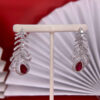
lab-grown diamond ring
III. Competitive Landscape: Traditional Jewelers Adapt, New Brands Innovate for Differentiation
- Legacy Retailers: From Resistance to Integration
Major U.S. jewelers, once hesitant to adopt lab-grown diamond, now see them as a growth driver:
- Signet Jewelers (Kay, Zales): lab-grown diamond account for 32% of its 2025 sales, up from 8% in 2022. It launched the “EcoGem” line, marketing lab-grown diamond as “carbon-neutral alternatives” with blockchain-backed carbon footprint tracking.
- Brilliant Earth: A pioneer in sustainable jewelry, it now sources 60% of its diamonds from LGD producers and reports a 45% year-over-year sales growth in 2025, driven by millennial and Gen Z shoppers.
- Even luxury brands are testing the waters: Cartier launched a limited-edition lab-grown diamondD bracelet in 2025, priced at USD 8,500, to gauge high-end demand.
- New Entrants: Niche Strategies to Capture Specific Audiences
- Tech-First Brands: Diamond Foundry emphasizes its “100% solar-powered production” (it operates a solar farm in California) and targets eco-conscious consumers. Its 3-carat lab-grown diamond engagement rings (USD 12,000) compete with 1-carat natural diamonds (USD 15,000).
- Customization Leaders: J.Paragon has built a loyal following with its “LifePrint” technology, which converts clients’ hair, pet fur, or even wedding flowers into carbon sources for lab-grown diamond. A custom 1-carat “memory diamond” costs USD 3,800, with an 89% repurchase rate (clients often order additional pieces for family members).
- Fast-Fashion Players: Walmart partners with Indian lab-grown diamond brand JeenMata to sell affordable pieces—like 0.5-carat stud earrings for USD 89—targeting budget shoppers. These products now make up 15% of Walmart’s jewelry sales.
IV. Pricing Dynamics: Cost Reductions Drive Accessibility, Stratification Emerges
- Retail Prices: A Steep Decline Makes LGDs Mainstream
- In 2025, a 1-carat LGD with G color and VS1 clarity retails for USD 900–1,000—only 20–25% of the price of a comparable natural diamond (USD 4,000–5,000). This price gap stems from two key factors:
- Scaled Production: CVD equipment costs have dropped 60% since 2020, and producers like Diamond Foundry now achieve economies of scale (it produces 50,000 carats annually, up from 10,000 in 2022).
- Global Supply Chains: China’s Henan province produces 76% of the world’s CVD LGD rough, while India’s Surat handles 87% of cutting and polishing—both regions offer lower labor and operational costs. For example, cutting a 1-carat LGD in Surat costs USD 12.3, vs. USD 45 in the U.S.
- Price Stratification: High-End vs. Mass Market
- Investment-Grade LGDs: 3+ carat, D-color, VVS1-clarity LGDs retail for USD 15,000–20,000—still 60–70% cheaper than natural diamonds of the same quality (USD 50,000–80,000). These are marketed to investors seeking “affordable luxury assets.”
- Mass-Market LGDs: Sub-1-carat LGDs now cost under USD 1,000, with some retailers (like Amazon) offering 0.3-carat pendants for USD 79. These products compete with cubic zirconia and moissanite, attracting first-time diamond buyers.
V. Consumer Perception: Trust Grows, Motivations Diversify
- Key Drivers of LGD Adoption
- Cost-Effectiveness: 62% of U.S. LGD buyers cite “value for money” as their top reason, according to a 2025 Pew Research survey. Gen Z (18–24) is particularly drawn to “carat freedom”—the ability to buy a larger diamond at a lower price.
- Environmental Concerns: 20% of buyers choose LGDs to avoid the environmental impact of diamond mining (which destroys 120 square meters of land per carat mined). Brands like Diamond Foundry and Brilliant Earth highlight this with marketing campaigns featuring their solar-powered facilities.
- Technological Appeal: 18% of buyers view LGDs as “futuristic” and “innovative.” A 2025 survey by Deloitte found that 70% of Gen Z shoppers would post their LGD jewelry on social media to “show their support for tech-driven sustainability.”
- Trust Building: Certification and Regulation
- The once-prevalent perception of LGDs as “fake diamonds” has faded, thanks to clearer standards:
- GIA’s New Rating System: In 2025, the Gemological Institute of America (GIA) replaced its traditional 4C grading for LGDs with a two-tier system (“Premium” for top-quality, “Standard” for mid-range) and requires explicit labeling of “lab-grown” and growth method (CVD/HPHT).
- FTC Oversight: The U.S. Federal Trade Commission (FTC) now mandates that all LGD products—online and in-store—display the label “laboratory-created” in font no smaller than the product name. It has also banned misleading terms like “synthetic” or “artificial,” which previously confused consumers.
VI. Policy and Supply Chain: U.S. Leads in Standards, China Dominates Production
- U.S. Policy: Support for Innovation, Trade Tensions
- R&D Funding: The U.S. Department of Energy (DOE) allocated USD 150 million in 2025 to fund LGD research, focusing on quantum computing and semiconductor applications. California offers a 30% tax rebate to LGD firms using 100% renewable energy.
- Trade Barriers: The Trump administration’s 27% tariff on Indian LGD rough (imposed in 2024) remains in place, prompting U.S. retailers to stockpile rough diamonds. By Q2 2025, the inventory-to-sales ratio for polished LGDs reached 8.6:1, up from 5.2:1 in 2024, as retailers avoid tariff-related cost hikes.
- Global Supply Chain: A Geographically Divided Ecosystem
- Upstream (Rough Production): China’s Henan province produces 76% of global CVD LGD rough, followed by the U.S. (19.3%). U.S. producers focus on high-value rough (3+ carats), while China dominates mid-range (1–2 carats).
- Midstream (Cutting/Polishing): India’s Surat is the global hub, handling 87% of LGD cutting. Its low labor costs (USD 3–5 per day per worker) and decades of diamond-processing expertise make it irreplaceable.
- Downstream (Retail): The U.S. is the world’s largest LGD consumer (37% of global sales), followed by China (26.5%). Online channels—including Brilliant Earth’s website and JD—account for 51.6% of U.S. LGD sales, as shoppers prioritize price comparison and transparency.
VII. Future Challenges and Long-Term Trends
- Immediate Risks: Overcapacity and Brand Saturation
- Overcapacity: Global LGD rough production capacity is expected to hit 120 million carats in 2025, but demand is only 38 million carats. Smaller producers in China and India have already begun shutting down, and price wars have pushed some U.S. startups to cut prices by 15–20% to stay competitive.
- Brand Clutter: With over 200 LGD brands now operating in the U.S., differentiation is becoming harder. Generic “eco-friendly” messaging is no longer enough—brands must invest in unique value propositions (like J.Paragon’s customization) to stand out.
- Long-Term Opportunities: Technology Fusion and New Markets
- Tech Integration: CVD diamonds are being combined with 3D printing to create complex optical components (e.g., lenses for medical imaging) and even “smart jewelry” (LGD-embedded fitness trackers that monitor heart rate).
- Industrial Expansion: By 2030, the industrial LGD market is projected to exceed USD 5 billion, driven by demand from semiconductors (for heat dissipation) and healthcare (dental drills and surgical tools, which benefit from LGD’s hardness and biocompatibility).
- ESG Mandates: The EU’s upcoming “Sustainable Jewelry Directive” (2026) will require all jewelers to disclose their products’ full lifecycle carbon emissions. LGDs—with 95% lower carbon footprints than natural diamonds—are well-positioned to gain market share as compliance becomes mandatory.
Conclusion
- 2025 marks a pivotal year for the U.S. LGD market: it has transitioned from a “disruptive novelty” to a mainstream option, driven by technological progress, consumer demand for affordability and sustainability, and clearer industry standards. While challenges like overcapacity and competition persist, LGDs have proven their resilience—especially in everyday consumption and high-tech industrial applications.
Looking ahead, the market will shift from “volume growth” to “value growth.” Success will belong to firms that master two skills: (1) leveraging technology to reduce costs while improving quality (e.g., larger, colorless LGDs) and (2) building emotional connections with consumers (e.g., customization, sustainability storytelling). For the broader diamond industry, LGDs are no longer a threat but a complement—creating a dual market where natural diamonds thrive on scarcity and LGDs excel at accessibility and innovation.
You must be logged in to post a comment.